- Comms
- Law
- Medic
- News
- Opinion
- Threat Watch
- Training
- Warrior Tools
- Accessories
- Ammo
- Body Armor
- Books
- Clothing
- Commo
- Gear
- Handguns
- Holsters
- Knives
- Long Guns
- ACC
- Accuracy International
- Barrett
- Benelli
- Beretta
- Blaser
- Bushmaster
- Custom
- CZ
- Desert Tactical Arms
- DPMS
- FN
- Forums
- HK
- IWI
- Kel-Tec Long Guns
- LaRue
- LWRC
- McMillan
- Mosin Nagant
- Mossberg
- Para
- Remington
- Rock River Arms
- Ruger Long Guns
- Sabre Defense
- Sako
- SIG Sauer
- SKS
- Smith & Wesson Long Guns
- Springfield
- Styer
- Weatherby
- Wilson Combat
- Winchester
- Magazines
- Maintenance
- Navigation
- Optics
- Sights
- Tech
- Warriors
Archive for category Threat Watch
The Battle No One Reported
Posted by Brian in News, Threat Watch, Warriors on 5/Apr/2011 12:57
Wired’s Danger Room has and excellent article on a battle that took place in Margah Afghanistan. It astounds me that some of the best war reporting going on right now is from a technology website:
It was the one of the biggest localized fights of the 10-year-old Afghanistan war — and one of the most lopsided battlefield victories for American forces. But the nearly 12-hour Battle of Margah barely registered in the news cycle back in America.
When the sun rose and the dust settled, 92 insurgents lay dead around the outpost, according to Army figures. Five Americans were wounded, but none was killed.
Many media outlets have seem to have forgotten that there is still fighting going on in Afghanistan. The media has taken the president’s announcement that troops will begin to withdraw in the summer, as a pretext to stop reporting on what is happening there and to make the president look good by not reporting stories like this one, where a massive battle took place.
AQAP and the Vacuum of Authority in Yemen
Posted by Brian in Opinion, Threat Watch on 31/Mar/2011 14:43
AQAP and the Vacuum of Authority in Yemen is republished with permission of STRATFOR.
By Scott Stewart
While the world’s attention is focused on the combat transpiring in Libya and the events in Egypt and Bahrain, Yemen has also descended into crisis. The country is deeply split over its support for Yemeni President Ali Abdullah Saleh, and this profound divide has also extended to the most powerful institutions in the country — the military and the tribes — with some factions calling for Saleh to relinquish power and others supporting him. The tense standoff in the Yemeni capital of Sanaa has served to divert attention (and security forces) from other parts of the country.
On March 28, an explosion at a munitions factory in southern Yemen killed at least 110 people. The factory, which reportedly produced AK rifles and ammunition, was located in the town of Jaar in Abyan province. Armed militants looted the factory March 27, and the explosion reportedly occurred the next day as local townspeople were rummaging through the factory. It is not known what sparked the explosion, but it is suspected to have been an accident, perhaps caused by careless smoking. Read the rest of this entry »
Al Qaeda’s Libya Pilgrimage
Posted by Gary in News, Threat Watch on 31/Mar/2011 10:12
From:Daily Beast by Sami Yousafzai
As the battle for the future of Libya continues, the excitement is almost palpable among Libyan-born al Qaeda fighters and other Arabs hunkered down in Pakistan’s remote and lawless tribal area. According to Afghan Taliban sources close to Osama bin Laden’s terrorist group, some of the 200 or so Libyans operating near the Afghan border may be on their way home to steer the anti-Gaddafi revolution in a more Islamist direction.
Reagan (CVN-76) Cleanup
Posted by Gary in Medic, News, Threat Watch, Warriors on 29/Mar/2011 08:23
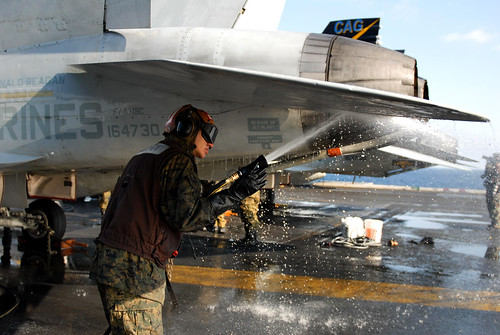
Marines wash the surface of an F/A-18C Hornet
Lance Cpl. Juan Olguin, from Lakewood, Calif., sprays the surface of an F/A-18C Hornet assigned to the Death Rattlers of Marine Fighter Attack Squadron (VMFA) 323 aboard the aircraft carrier USS Ronald Reagan during a countermeasure wash down on the flight deck. Sailors scrubbed the external surfaces on the flight deck and island superstructure to remove potential radiation contamination. Ronald Reagan is operating off the coast of Japan providing humanitarian assistance as directed in support of Operation Tomodachi.
Iranian hackers obtain fraudulent HTTPS certificates
Posted by Gary in Comms, News, Threat Watch on 28/Mar/2011 18:38
From: EFF
Iranian hackers obtain fraudulent HTTPS certificates: How close to a Web security meltdown did we get?
On March 15th, an HTTPS/TLS Certificate Authority (CA) was tricked into issuing fraudulent certificates that posed a dire risk to Internet security. Based on currently available information, the incident got close to – but was not quite – an Internet-wide security meltdown. These events show why we urgently need to start reinforcing the system that is currently used to authenticate and identify secure websites and email systems.
Reagan Crew Works to Keep Radiation Contamination Down
Posted by Gary in Medic, Threat Watch, Warriors on 28/Mar/2011 14:26

Navy crew members mop the flight deck March 23 to remove radioactive contamination from the aircraft carrier Ronald Reagan off the Japanese coast.
From: Marine Corps Times
… “I don’t know of any aircraft carrier that’s ever been contaminated like this,†he said.
Powell, the radiation officer, said that he only got two hours of sleep from Sunday until Wednesday. By then, things had calmed down significantly.
That doesn’t mean, however, that the ship has lowered its vigilance. Visitors coming aboard even nine days later were thoroughly checked, as are crews still coming back from relief missions.
The mass cleanup of the ship’s surface Wednesday was considered largely successful, although commanding officer Capt. Thom Burke, in an announcement over the vessel’s public address system the next day, said that some “hot spots†remained.
More than 2,000 U.S. Marines are on the ground in Libya
Posted by Jack Sinclair in News, Threat Watch, Warriors on 27/Mar/2011 15:33
“An ABC affiliate in North Carolina says more than 2,000 U.S. Marines are on the ground in Libya.
WCTI-TV in New Bern reports those Marines, assigned to the 26th Marine Expeditionary Unit (MEU) at Camp Lejuene, are “preserving the sanctity of the city [of Ajdubiyah] and the safety of the civilians within it.”
Capt. Timothy Patrick with the 26th MEU told the station: “In Libya right now they are doing exactly what we need them to do. They are doing what they are told, and right now that’s protecting Libyan people against Qadhafi forces.”
USB Drives left at Dry Cleaners on the Rise
Posted by Gary in Comms, News, Threat Watch on 25/Mar/2011 14:59
Encrypt your USB Drives
From: SC Magazine UK
A survey of dry cleaners in the UK has found that more than 17,000 USB sticks were left behind in 2010.
More than 500 dry cleaners and launderettes in the UK were asked during December 2010 and January 2011 about removable media that was left behind. Estimated figures suggested that there was an increase on the number of USB sticks left in dry cleaners of more than 400 per cent when compared with figures from 2009, and almost double from what was found in 2008.
…With the best intentions in the world, the reality is devices are often left behind and the information they contain could be devastating if disclosed. Organizations need to plan for this when developing their security strategies.â€
Libya’s Terrorism Option
Posted by Brian in News, Threat Watch on 24/Mar/2011 11:22
Libya’s Terrorism Option is republished with permission of STRATFOR.
By Scott Stewart
On March 19, military forces from the United States, France and Great Britain began to enforce U.N. Security Council Resolution 1973, which called for the establishment of a no-fly zone over Libya and authorized the countries involved in enforcing the zone to “take all necessary measures†to protect civilians and “civilian-populated areas under threat of attack.†Obviously, such military operations cannot be imposed against the will of a hostile nation without first removing the country’s ability to interfere with the no-fly zone — and removing this ability to resist requires strikes against military command-and-control centers, surface-to-air missile installations and military airfields. This means that the no-fly zone not only was a defensive measure to protect the rebels — it also required an attack upon the government of Libya.
Certainly, Libyan leader Moammar Gadhafi has no doubt that the U.S. and European military operations against the Libyan military targets are attacks against his regime. He has specifically warned France and the United Kingdom that they would come to regret the intervention. Now, such threats could be construed to mean that should Gadhafi survive, he will seek to cut off the countries’ access to Libyan energy resources in the future. However, given Libya’s past use of terrorist strikes to lash out when attacked by Western powers, Gadhafi’s threats certainly raise the possibility that, desperate and hurting, he will once again return to terrorism as a means to seek retribution for the attacks against his regime. While threats of sanctions and retaliation have tempered Gadhafi’s use of terrorism in recent years, his fear may evaporate if he comes to believe he has nothing to lose. Read the rest of this entry »
RSA compromise: Impacts on SecurID
Posted by Gary in Comms, News, Threat Watch on 23/Mar/2011 14:36
From: Dell SecureWorks
 RSA is the security division of EMC software, best known for the popular SecurID two-factor authentication tokens used in high-security environments including some government networks. RSA announced that a cyberattack resulted in the compromise and disclosure of information “specifically related to RSA’s SecurID two-factor authentication products”. The full extent of the breach remains publicly unknown. RSA states that “this information could potentially be used to reduce the effectiveness of a current two-factor authentication implementation as part of a broader attack.” Organizations that make use of SecurID should be alert for attempts at circumventing their authentication infrastructure, though no specific attacks are known to be occurring at the time of this publication.
RSA’s breach disclosure
On March 17, 2011, RSA announced [1] that a cyberattack on its systems was successful and resulted in the compromise and disclosure of information “specifically related to RSA’s SecurID two-factor authentication products”. While the full extent of the breach remains publicly undisclosed, RSA states that “this information could potentially be used to reduce the effectiveness of a current two-factor authentication implementation as part of a broader attack.”
Marines rescue downed pilot in Libya
Posted by Gary in News, Threat Watch, Warriors on 22/Mar/2011 15:36
From: Marine Corp Times
The pilot of a downed Air Force F-15 Strike Eagle fighter jet in Libya was reportedly rescued by Marines in an MV-22 Osprey, media reports said.
The jet crashed late Monday after two crew members safely ejected, U.S. Africa Command said in a statement. The aircraft, based out of RAF Lakenheath, England, was flying out of Aviano Air Base, Italy, in support of a no-fly zone approved by the U.N.
Meghan Brown killed attacker with her pink .38
Posted by Jack Sinclair in Law, News, Threat Watch, Warriors on 21/Mar/2011 20:21

TIERRA VERDE — “Meghan Brown had fired her pink .38-caliber handgun only inside a shooting range. Even there, she said, she wasn’t very good.
The 2009 Miss Tierra Verde, 25 and a slender brunet, had trouble pulling back the trigger. When she did manage, she said she almost never hit the target.
That Saturday was different.
A man barged into her home, attacking her and beating her fiance … She trained it on the man, following his movements as he tussled with her fiance.
She saw an opening. She pulled the trigger. Pop. Pop. Pop. Pop.
Albert F. Hill, 42, never got up.”
“I’m glad it was me,” Brown said. “Not everybody else is that prepared, you know what I mean. Not everybody else is walking around with a loaded .38.”
Countering Global Insurgency
Posted by Gary in Threat Watch, Training on 21/Mar/2011 17:09
From: Counterinsurgency by David Kilcullen
Countering Global Insurgency
Since the United States declared a global “war on terrorism†following the 9/11 terrorist attacks, some analysts have argued that terrorism is merely a tactic, thus a war on terrorism makes little sense. Francis Fukuyama’s comment that ” the war on terror” is a misnomer… terrorism is only a means to an end; in this regard, a war on terrorism makes no more sense than a war on submarines†is typical. This view is irrelevant in a policy sense (the term “war on terrorism†is a political, not an analytical, expression) but nonetheless accurate. Indeed, to paraphrase Clausewitz, to wage this war effectively, we must understand its true nature: neither mistaking it for nor trying to turn it into something it is not. We must distinguish Al Qaeda and the broader militant movements it symbolizes—entities that use terrorism—from the tactic of terrorism itself. In practice, as I will demonstrate, the “war on terrorism” is a defensive war against a worldwide Islamist jihad, a diverse confederation of movements that uses terrorism as its principle—but not its sole—tactic.
– Excerpt from,  Counterinsurgency by David Kilcullen  -2010
Radiation Cancer Risks
Posted by Gary in Medic, News, Threat Watch on 17/Mar/2011 15:11
Radiation Cancer Risks
U.S. Army guidelines for safety in radioactive environments.

Taming Chaos with a Personal Plan
Posted by Brian in Comms, Opinion, Threat Watch on 17/Mar/2011 14:53
Taming Chaos with a Personal Plan is republished with permission of STRATFOR.
By Scott Stewart
Over the past week we’ve seen a massive earthquake and tsunami in Japan that caused a nuclear accident, the Saudis sending troops into Bahrain to quell civil unrest there and the government of Yemen taking measures to expel foreign media as protests have swelled against Yemeni President Ali Abdullah Saleh.
We have also recently seen large-scale evacuations of expatriates from Tunisia, Egypt and Libya, and it is not unreasonable to assume that we might see a similar exodus from Bahrain and Yemen if developments in those countries deteriorate. Moreover, in Japan, the risk of radiation and conditions that are not yet under control at the Fukushima Daiichi nuclear power plant could force further evacuations there.
In light of this uncertain environment, STRATFOR thought it prudent to address once again the topic of personal contingency planning. Indeed, we also made this topic the subject of this week’s  Above the Tearline video. While we have often discussed this topic in relation to terrorist attacks, its principles are also readily applicable to crises caused by natural disaster, war and civil unrest. When a crisis erupts, having an established personal contingency plan provides people with a head start and a set of tools that can help them avoid, or at least mitigate, the effects of the chaos and panic that accompany crisis events. Read the rest of this entry »