- Comms
- Law
- Medic
- News
- Opinion
- Threat Watch
- Training
- Warrior Tools
- Accessories
- Ammo
- Body Armor
- Books
- Clothing
- Commo
- Gear
- Handguns
- Holsters
- Knives
- Long Guns
- ACC
- Accuracy International
- Barrett
- Benelli
- Beretta
- Blaser
- Bushmaster
- Custom
- CZ
- Desert Tactical Arms
- DPMS
- FN
- Forums
- HK
- IWI
- Kel-Tec Long Guns
- LaRue
- LWRC
- McMillan
- Mosin Nagant
- Mossberg
- Para
- Remington
- Rock River Arms
- Ruger Long Guns
- Sabre Defense
- Sako
- SIG Sauer
- SKS
- Smith & Wesson Long Guns
- Springfield
- Styer
- Weatherby
- Wilson Combat
- Winchester
- Magazines
- Maintenance
- Navigation
- Optics
- Sights
- Tech
- Warriors
Archive for category Threat Watch
Cyber combat: act of war
Posted by Gary in Comms, Threat Watch on 3/Jun/2011 14:42
From: WSJ via Kurzweil AI
Cyber combat: act of war
June 1, 2011
Source: Wall Street Journal — May 31, 2011
The Pentagon has concluded that computer sabotage coming from another country can constitute an act of war, opening the door for the U.S. to respond using traditional military force.
Pentagon officials believe the most sophisticated computer attacks require the resources of a government. For instance, the weapons used in an assault such as taking down a power grid would likely have been developed with state support.
Defense officials refuse to discuss potential cyber adversaries, although military and intelligence officials say they have identified previous attacks originating in Russia and China.
Topics: Computers/Infotech/UI | Survival/Defense
Iraqi Shiite Militias Contine to Pose a Threat as U.S. Forces Leave
Posted by Jack Sinclair in News, Threat Watch on 28/May/2011 00:18
“The attacks on the Americans in Maysan Province, near the Iranian border, and elsewhere in southern Iraq provide one of the starkest examples of what officials call a reinvigorated threat posed by Shiite militants and followers of the anti-American Shiite cleric Moktada al-Sadr during the American military’s waning days here.
These Shiite militias have emerged as perhaps the greatest threat to the 46,000 United States troops still in Iraq, military officials say. And a barrage of recent attacks — some of them deadly — has raised questions about the safety of Americans as the military withdraws troops and equipment in the months ahead.
“There are plenty of groups who will be paid to kill the last Americans on their way out,†said Col. Douglas Crissman, the military commander who oversees Maysan and three other southern provinces.”
http://www.nytimes.com/2011/05/27/world/middleeast/27shiite.html?_r=1&partner=rss&emc=rss
U.S. Tells Its Afghan Workers: No Torture, Corpse Mutilation
Posted by Jack Sinclair in Law, News, Threat Watch on 27/May/2011 19:46
“It’s never a good sign when you have to tell the men guarding your base not to murder civilians, torture detainees or desecrate corpses. But U.S. special-operations forces in Afghanistan are leaving nothing to chance.
… there are uniform expectations for would-be guards. Some of them read more like baseline conditions for membership in civilized humanity.
So-called “Afghan Security Guards†are instructed, “Do not kill or torture detained personnel.†For good measure, if someone’s taken captive, “immediately turn over to U.S., Coalition or [Afghan forces].†Should they kill someone who poses a threat, there is to be “no booby-trapping, burning [or] mutilation†of their corpses.
Afghans guarding U.S. bases don’t exactly have the best track record.”

Iran Attempting to Acquire Helicopters With Nuke Capability
Posted by Jack Sinclair in News, Threat Watch on 27/May/2011 18:24
By William Chedsey
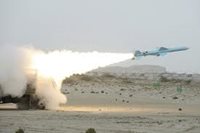
Noor Missile (AP)
“The arrest on Thursday of five Spanish businessmen and three Iranians allegedly planning to smuggle into Iran military helicopters formerly owned by Israel sparks concerns over the possible use of nuclear-armed cruise missiles by Tehran’s Islamist regime.
Five years ago, Iran successfully test-fired in the Persian Gulf its “Noor” long-range cruise missile, based on China’s C-802 anti-ship cruise design. The launch platform utilized in the April 2006 test was believed to be a Russian Mil-17 helicopter.
The Noor has a range of 200 kilometers, reportedly with no need of an over-the-horizon targeting system. Its velocity is twice the speed of sound, it travels just a few yards above water, and it is close to undetectable by radar. The Noor’s single-shot kill probability has been estimated at nearly 98 percent.”
The strategic threat of EMP (Electromagnetic Pulse) – Newt Gingrich
Posted by Jack Sinclair in News, Threat Watch on 27/May/2011 17:50
“Select excerpts from exclusive video address by Former Speaker of the House Newt Gingrich regarding EMPACT America’s EMP conference in Niagara Falls, NY on September 8th – 10th, 2009, including – I’ve believed for a long time that EMP (or Electromagnetic Pulse) may be the greatest strategic threat we face because, without adequate preparation, its impact would be so horrifying that we would in fact loose our civilization in a matter of seconds.
It’s very important to get people to understand now, before there’s a disaster, how truly grave the threat is – and with EMPACT America’s help, we can provide the leadership, the communications, and the information that can help the American people protect themselves from a truly disastrous threat.
A man-made Electromagnetic Pulse (EMP) is caused by a nuclear weapon detonated in the atmosphere. This threat is a realistic possibility in this day and age. In fact, two Congressional Commissions have recently warned that America could suffer catastrophic consequences from a nuclear EMP attack by terrorists or rogue states. Their reports also point out that the U.S. can be protected if we act quickly.
A House Homeland Security subcommittee is considering legislation, but very little has been done so far. According to the Abstract of the original Report of the Commission to Assess the Threat to the United States from EMP Attack, U.S. Congress, 2004: Several potential adversaries have or can acquire the capability to attack the United States with a high-altitude nuclear weapon-generated electromagnetic pulse (EMP).
A determined adversary can achieve an EMP attack capability without having a high level of sophistication. An EMP attack can cripple our infrastructure causing all of our electronic equipment and infrastructure to fail.
That means even basic modes of emergency response, like cars, planes, and other emergency vehicles, may not even start. Current emergency planning is primarily based upon short-term disasters, and is heavily dependent upon assistance from peripheral communities; unfortunately, an EMP could have long-lasting and wide-spread effects that are not adequately addressed by current planning. Moreover, availability of fundamental resources such as our food, water, and medical supplies would almost certainly break down.
Don’t think it can happen? Increasing nuclear terrorist threats like those of North Korea and Iran can disable the entire power grid in North America are a clear and present danger. Terrorists and rouge nations don’t even need accurate or long range ballistic missiles. An EMP attack can potentially be carried out by launching readily available Scud missiles from a barge off of our coast(s).”
The Bin Laden Operation: Tapping Human Intelligence
Posted by Brian in Opinion, Threat Watch on 26/May/2011 17:29
The Bin Laden Operation: Tapping Human Intelligence is republished with permission of STRATFOR.
By Fred Burton
Since May 2, when U.S. special operations forces crossed the Afghan-Pakistani border and killed Osama bin Laden, international media have covered the raid from virtually every angle. The United States and Pakistan have also squared off over the U.S. violation of Pakistan’s sovereign territory and  Pakistan’s possible complicity in hiding the al Qaeda leader. All this surface-level discussion, however, largely ignores almost 10 years of intelligence development in the hunt for bin Laden.
While the cross-border nighttime raid deep into Pakistan was a daring and daunting operation, the work to find the target — one person out of 180 million in a country full of insurgent groups and a population hostile to American activities on its soil — was a far greater challenge. For the other side, the challenge of hiding the world’s most wanted man from the world’s most funded intelligence apparatus created a clandestine shell game that probably involved current or former Pakistani intelligence officers as well as competing intelligence services. The details of this struggle will likely remain classified for decades.
Examining the hunt for bin Laden is also difficult, mainly because of the sensitivity of the mission and the possibility that some of the public information now available could be disinformation intended to disguise intelligence sources and methods. Successful operations can often compromise human sources and new intelligence technologies that have taken years to develop. Because of this, it is not uncommon for intelligence services to try to create a wilderness of mirrors to protect sources and methods. But using open-source reporting and human intelligence from STRATFOR’s own sources, we can assemble enough information to draw some conclusions about this complex intelligence effort and raise some key questions. Read the rest of this entry »
Obama and the Arab Spring
Posted by Brian in News, Threat Watch on 25/May/2011 14:23
Obama and the Arab Spring is republished with permission of STRATFOR.
By George Friedman
U.S. President Barack Obama gave a speech last week on the Middle East. Presidents make many speeches. Some are meant to be taken casually, others are made to address an immediate crisis, and still others are intended to be a statement of broad American policy. As in any country, U.S. presidents follow rituals indicating which category their speeches fall into. Obama clearly intended his recent Middle East speech to fall into the last category, as reflecting a shift in strategy if not the declaration of a new doctrine.
While events in the region drove Obama’s speech, politics also played a strong part, as with any presidential speech. Devising and implementing policy are the president’s job. To do so, presidents must be able to lead — and leading requires having public support. After the 2010 election, I said that presidents who lose control of one house of Congress in midterm elections turn to foreign policy because it is a place in which they retain the power to act. The U.S. presidential campaign season has begun, and the United States is engaged in wars that are not going well. Within this framework, Obama thus sought to make both a strategic and a political speech. Read the rest of this entry »
Al-Qaeda’s “Chip-Away” strategy: smaller scale attacks
Posted by Jack Sinclair in Threat Watch on 14/May/2011 21:46
Al Qaeda’s Leadership in Yemen
Posted by Brian in News, Threat Watch on 12/May/2011 12:51
Al Qaeda’s Leadership in Yemen is republished with permission of STRATFOR.
By Scott Stewart
On May 5, a Hellfire missile fired from a U.S. unmanned aerial vehicle (UAV) struck a vehicle in the town of Nissab in Yemen’s restive Shabwa province. The airstrike reportedly resulted in the deaths of two Yemeni members of the Yemen-based al Qaeda franchise group al Qaeda in the Arabian Peninsula (AQAP) and injured a third AQAP militant. Subsequent media reports indicated that the strike had targeted Anwar al-Awlaki, a U.S.-born member of AQAP, but had failed to kill him.
The May 5 strike was not the first time al-Awlaki had been targeted and missed. On Dec. 24, 2009 (a day before the failed AQAP Christmas Day bombing attempt against Northwest Airlines Flight 253), an airstrike and ground assault was launched against a compound in the al-Said district of Shawba province that intelligence said was the site of a major meeting of AQAP members. The Yemeni government initially indicated that the attack had killed al-Awlaki along with several senior AQAP members, but those reports proved incorrect.
In 2009 and 2010, the United States conducted other strikes against AQAP in Yemen, though most of those strikes reportedly involved Tomahawk cruise missiles and carrier-based fixed-wing aircraft. Still, the United States has reportedly used UAVs to attack targets in Yemen on a number of occasions. In November 2002, the CIA launched a UAV strike against Abu Ali al-Harithi and five confederates in Marib. That strike essentially decapitated the al Qaeda node in Yemen and greatly reduced its operational effectiveness for several years. There are also reports that a May 24, 2010, strike may have been conducted by a UAV. However, that strike mistakenly killed the wrong target, which generated a great deal of anger among Yemen’s tribes, who then conducted armed attacks against pipelines and military bases. The use of airstrikes against AQAP was heavily curtailed after that attack. Read the rest of this entry »
U.S. Border Patrol to its agents: stop arresting illegal aliens to “keep illegal immigration numbers down”.
Posted by Jack Sinclair in Law, News, Threat Watch on 10/May/2011 18:53
“The U.S. Border Patrol has told its agents to stop arresting illegal aliens crossing the border from Mexico to keep the illegal immigration numbers down, Arizona Sheriff Larry Dever tells Newsmax.
He also charges that Attorney General Eric Holder is “holding hands with the ACLU†to protect illegal aliens from prosecution, says illegals are committing “heinous crimes†across America every day, and calls claims that the federal government should be solely responsible for controlling illegal immigration “balderdash.â€
Dever is sheriff of Cochise County, which shares an 83-mile border with Mexico, and he says his Border Patrol sector is responsible for half of all illegal aliens caught trying to enter the country and halt the narcotics entering the United States.”
U.S.-Pakistani Relations Beyond Bin Laden
Posted by Brian in News, Threat Watch on 10/May/2011 14:15
U.S.-Pakistani Relations Beyond Bin Laden is republished with permission of STRATFOR.
By George Friedman
The past week has been filled with announcements and speculations on how Osama bin Laden was killed and on Washington’s source of intelligence. After any operation of this sort, the world is filled with speculation on sources and methods by people who don’t know, and silence or dissembling by those who do.
Obfuscating on how intelligence was developed and on the specifics of how an operation was carried out is an essential part of covert operations. The precise process must be distorted to confuse opponents regarding how things actually played out; otherwise, the enemy learns lessons and adjusts. Ideally, the enemy learns the wrong lessons, and its adjustments wind up further weakening it. Operational disinformation is the final, critical phase of covert operations. So as interesting as it is to speculate on just how the United States located bin Laden and on exactly how the attack took place, it is ultimately not a fruitful discussion. Moreover, it does not focus on the truly important question, namely, the future of U.S.-Pakistani relations.
Posturing Versus a Genuine Breach
It is not inconceivable that Pakistan aided the United States in identifying and capturing Osama bin Laden, but it is unlikely. This is because the operation saw the already-tremendous tensions between the two countries worsen rather than improve. The Obama administration let it be known that it saw Pakistan as either incompetent or duplicitous and that it deliberately withheld plans for the operation from the Pakistanis. For their part, the Pakistanis made it clear that further operations of this sort on Pakistani territory could see an irreconcilable breach between the two countries. The attitudes of the governments profoundly affected the views of politicians and the public, attitudes that will be difficult to erase. Read the rest of this entry »
Smugglers Guide Illegal Immigrants With Cellphones
Posted by Jack Sinclair in News, Threat Watch on 9/May/2011 22:17

John Moore/Getty Images A member of the Arizona National Guard on duty at the border. So-called coyotes are using technology to help avoid patrols.
NOGALES, Ariz. — “A group of migrants was hustling north through the southern Arizona desert the other night when one of their cellphones vibrated with a text message. “Watch out,†it warned. “Things are hot up ahead. Take cover in the bushes.â€
Some border crossers are getting help from smugglers who track patrols from afar and send texts on how to avoid them.
The message, signaling the presence of the Border Patrol, was sent by a smuggler watching the group’s progress through binoculars from a hillside on the Mexican side of the border, members of the group said later. It was part of what border officials and immigrant activists say is an emerging trend in illegal border crossing — the use of what is being called the cybercoyote.
“I’ve crossed eight times, and this is the first time they’ve directed me with my cellphone,†said Sandra Silva, 30, a native of Guadalajara, Mexico, who was on her way to Phoenix. “It’s like a guide through the desert.â€
http://www.nytimes.com/2011/05/09/us/09coyotes.html?_r=1&partner=rss&emc=rss
Arizona Sheriff: “Don’t drink the Kool-Aid and buy into this ‘border is secure’ nonsense.”
Posted by Jack Sinclair in News, Threat Watch on 9/May/2011 18:50
“For the secretary of homeland security to say the border is more secure than ever, well, I’ve been there forever and there was a happier time than what it is today. We have a long, long way to go.
“Don’t drink the Kool-Aid and buy into this ‘border is secure’ nonsense.
“There’s a bad element in the mix of the aliens that are crossing that border and they don’t stay there, they move into communities throughout the country. And every day there are travesties and heinous crimes being committed by those people. If we don’t stop it at the border, it’s just going to continue to grow.â€
[Arizona Sheriff Larry] Dever recently told Congress that in one district in Texas, illegals are allowed to be caught crossing the border 14 times before being charged with a felony, and federal smuggling charges are not considered unless at least six illegal aliens are being smuggled into the country.”
Lt. Col. (Ret.) Allen West: Define the Enemy
Posted by Brian in Opinion, Threat Watch, Warriors on 8/May/2011 22:31
I am not sure when this speech was given but it was uploaded in Sept. 2009. Allen West is the only person I have seen who speaks plainly about the enemy we face. I value his opinion over any politician’s since he has been to both Iraq and Afghanistan and fought the enemy.
How far have Mexican drug cartels moved into the US? Arizona Sheriff Larry Dever responds
Posted by Jack Sinclair in News, Threat Watch on 7/May/2011 18:16
Dever: Mexican drug cartels are freely operating many miles from the U.S.-Mexican border.
“You can go up to 70 miles north in Pinal County, which isn’t even a border county, and the Bureau of Land Management put up signs on public land warning people not to travel there because of the threat from drug cartels.
“If you travel into the recreational areas in my county, those same signs are up warning people they could encounter drug and human smuggling. I think we ought to point the signs south and tell the folks who are coming here that this is not a safe place for you to come.â€
He also explains how he has heard that the Border Patrol has told officers to stop arresting Mexican illegals to keep official illegal immigration figures down.
“That comes from agents on the ground, who have told me, told my deputies, told citizens in the area. They have in the past been instructed to scare people back or turn them back south versus arresting them.â€