- Comms
- Law
- Medic
- News
- Opinion
- Threat Watch
- Training
- Warrior Tools
- Accessories
- Ammo
- Body Armor
- Books
- Clothing
- Commo
- Gear
- Handguns
- Holsters
- Knives
- Long Guns
- ACC
- Accuracy International
- Barrett
- Benelli
- Beretta
- Blaser
- Bushmaster
- Custom
- CZ
- Desert Tactical Arms
- DPMS
- FN
- Forums
- HK
- IWI
- Kel-Tec Long Guns
- LaRue
- LWRC
- McMillan
- Mosin Nagant
- Mossberg
- Para
- Remington
- Rock River Arms
- Ruger Long Guns
- Sabre Defense
- Sako
- SIG Sauer
- SKS
- Smith & Wesson Long Guns
- Springfield
- Styer
- Weatherby
- Wilson Combat
- Winchester
- Magazines
- Maintenance
- Navigation
- Optics
- Sights
- Tech
- Warriors
Posts Tagged terrorism
Iraqi Pleads Guilty To Terrorism
Posted by Brian in News, Threat Watch on 23/Aug/2012 02:23
Iraqi National Pleads Guilty to 12-Count Terrorism Indictment in Kentucky
Aug. 21, 2012
– Louisville
The Absurd Trial of Major Hassan
Posted by Brian in News, Threat Watch on 13/Aug/2012 08:52
According to Time’s Battleland blog, Major Hassan is refusing to shave his beard as required by military protocol, causing his trial to be delayed. He didn’t have a problem shaving during his service and before he massacred his fellow soldiers.
His defense counsel told the judge the beard is an expression of his religious conviction and should be allowed as such, but Gross has overruled their arguments and ordered Hasan out of the courtroom until he complies with army regulations.
Killeen Bomb Plotter Sentenced to Life
Posted by Brian in News, Threat Watch on 12/Aug/2012 02:18
Naser Jason Abdo Sentenced to Life in Federal Prison in Connection with Killeen Bomb Plot
Aug. 10, 2012
– San Antonio
FBI: Man Gets 20yrs for Supporting al-Qaeda
Posted by Brian in News, Threat Watch on 22/Jul/2012 08:42
Texas Man Sentenced for Supporting Terrorism
An American-born man has been sentenced to 20 years in prison for attempting to provide material support to al Qaeda in the Arabian Peninsula.
– Gotcha
President Attempts To Bypass Watergate Era Spying Laws
Posted by Brian in Law, News, Threat Watch on 1/Jun/2012 19:11
From Wired’s Threat Level:
The Obama administration is set to argue to a federal appeals court Friday(today) that the government may breach, with impunity, domestic spying laws adopted in the wake of President Richard M. Nixon’s Watergate scandal.
The case tests whether Americans may seek recourse or monetary damages when a sitting U.S. president bypasses Congress’s ban on warrantless spying on Americans — in this instance when President George W. Bush authorized his secret, warrantless domestic spying program in the aftermath of the September 2001 terror attacks.
Terrorism and the Not-So-Exceptional Individual
Posted by Brian in News, Opinion, Threat Watch on 24/May/2012 16:35
By Scott Stewart
In last week’s Security Weekly, we used a thwarted underwear bomb plot, as well as the U.S. government’s easing the rules of engagement for unmanned aerial vehicle strikes in Yemen, as an opportunity to examine the role of exceptional individuals in militant groups that conduct terrorist attacks. Al Qaeda in the Arabian Peninsula’s (AQAP’s) innovative bombmaker, Ibrahim al-Asiri, is one such individual.
Reported by AP on May 7, the news of the thwarted underwear plot overshadowed another event in Yemen that occurred May 6: a U.S. airstrike in Shabwa province that killed Fahd al-Quso, a Yemeni militant wanted for his involvement in the attack against the USS Cole in October 2000. Al-Quso appeared in a video released by AQAP’s al-Malahim Media in May 2010, during which he threatened attacks against the continental United States, its embassy in Yemen and warships in the waters surrounding Yemen. Read the rest of this entry »
Terrorism and the Exceptional Individual
Posted by Brian in Threat Watch on 17/May/2012 18:16
By Scott Stewart
There has been a lot of chatter in intelligence and academic circles about al Qaeda in the Arabian Peninsula (AQAP) bombmaker Ibrahim al-Asiri and his value to AQAP. The disclosure last week of a thwarted AQAP plot to attack U.S. airliners using an improved version of an “underwear bomb” used in the December 2009 attempted attack aboard a commercial airplane and the disclosure of the U.S. government’s easing of the rules of engagement for unmanned aerial vehicle strikes in Yemen played into these discussions. People are debating how al-Asiri’s death would affect the organization. A similar debate undoubtedly will erupt if AQAP leader Nasir al-Wahayshi is captured or killed.
AQAP has claimed that al-Asiri trained others in bombmaking, and the claim makes sense. Furthermore, other AQAP members have received training in constructing improvised explosive devices (IEDs) while training and fighting in places such as Iraq and Afghanistan. This means that al-Asiri is not the only person within the group who can construct an IED. However, he has demonstrated creativity and imagination. His devices consistently have been able to circumvent existing security measures, even if they have not always functioned as intended. We believe this ingenuity and imagination make al-Asiri not merely a bombmaker, but an exceptional bombmaker.
Likewise, al-Wahayshi is one of hundreds — if not thousands — of men currently associated with AQAP. He has several deputies and numerous tactical field commanders in various parts of Yemen. Jihadists have had a presence in Yemen for decades, and after the collapse of al Qaeda in Saudi Arabia, numerous Saudi migrants fleeing the Saudi government augmented this presence. However, al-Wahayshi played a singular role in pulling these disparate jihadist elements together to form a unified and cohesive militant organization that has been involved not only in several transnational terrorist attacks but also in fighting an insurgency that has succeeded in capturing and controlling large areas of territory. He is an exceptional leader.
Individuals like al-Asiri and al-Wahayshi play critical roles in militant groups. History has shown that the loss of exceptional individuals such as these makes a big difference in efforts to defeat such organizations. Read the rest of this entry »
Searching for Connections Amid Terrorist Threats
Posted by Brian in Opinion, Threat Watch on 10/May/2012 15:45
By Scott Stewart
In past Security Weeklies we have often noted how analyzing terrorism is like assembling a puzzle. After an attack has transpired, it is easier to piece the disparate clues together because you have the luxury of knowing what the finished puzzle should look like. You know the target, the method of attack, the time, the place, etc. These factors frame your approach to the bits of evidence you gather and allow you to assemble them into a cohesive, logical framework. While there will certainly be missing pieces at times, having the reference point of the attack itself is helpful to investigators and analysts.
On the other hand, analyzing a potential threat before an attack takes place is far more difficult. It is like sifting through pieces of thousands of different puzzles, all jumbled together in one big pile, and attempting to create a complete picture without knowing what the end result — the attack — will look like. Sometimes pieces look like they could be related, but it is often difficult to determine if they really are without having the picture of the finished attack and the important framework for investigative reference: target, method of attack, time and place. It is often easy to look back after an attack and criticize authorities for not making a critical connection, but it is difficult to piece things together before the attack occurs without the assistance of hindsight. Read the rest of this entry »
Tactical Realities of the Toulouse Shootings
Posted by Brian in Opinion, Threat Watch on 8/Apr/2012 12:22
From STRATFOR:
By Scott Stewart
Mohammed Merah, the suspect in a string of violent attacks culminating with the March 19 shooting deaths of three children and a rabbi at the Ozar Hatorah School in Toulouse, France, committed suicide by cop March 22 after a prolonged standoff at his Toulouse apartment. Authorities believed Merah also to have shot and killed a paratrooper March 11 in Toulouse and two other paratroopers March 15 in Montauban.
While Merah’s death ended his attacks, it also began the inevitable inquiry process as French officials consider how the attacks could have been prevented. The commissions or committees appointed to investigate such attacks normally take months to complete their inquiries, so the findings of the panel looking into the Merah case will not be released in time to have any impact on the French presidential election set to begin April 22. However, such findings are routinely used for political purposes and as ammunition for bureaucratic infighting. Read the rest of this entry »
A Practical Guide to Situational Awareness
Posted by Brian in News, Threat Watch on 16/Mar/2012 12:04
From STRATFOR:
By Scott Stewart
For the past three weeks we have been running a series in the Security Weekly that focuses on some of the fundamentals of terrorism. First, we noted that terrorism is a tactic not exclusive to any one group and that the tactic would not end even if the jihadist threat were to disappear. We then discussed how actors planning terrorist attacks have to follow a planning process and noted that there are times during that process when such plots are vulnerable to detection.
Last week we discussed how one of the most important vulnerabilities during the terrorism planning process is surveillance, and we outlined what bad surveillance looks like and described some basic tools to help identify those conducting it. At the end of last week’s Security Weekly we also discussed how living in a state of paranoia and looking for a terrorist behind every bush not only is dangerous to one’s physical and mental health but also results in poor security. This brings us to this week, where we want to discuss the fundamentals of situational awareness and explain how people can practice the technique in a relaxed and sustainable way.
Situational awareness is very important, not just for personal security but as a fundamental building block in collective security. Because of this importance, Stratfor has written about situational awareness many times in the past. However, we believe it merits repeating again in order to share these concepts with our new readers as well as serve as a reminder for our longtime readers. Read the rest of this entry »
Detecting Terrorist Surveillance
Posted by Brian in News, Threat Watch on 12/Mar/2012 10:00
This is a report from STRATFOR:
By Scott Stewart
As we noted last week, terrorist attacks do not materialize out of thin air. In fact, quite the opposite is true. Those planning terrorist attacks follow a discernable process referred to as the terrorist attack cycle. We also discussed last week how terrorism planners are vulnerable to detection at specific points during their attack cycle and how their poor surveillance tradecraft is one of these vulnerable junctures.
While surveillance is a necessary part of the planning process, the fact that it is a requirement does not necessarily mean that terrorist planners are very good at it. With this in mind, let’s take a closer look at surveillance and discuss what bad surveillance looks like. Read the rest of this entry »
The Myth of the End of Terrorism
This is a report from STRATFOR:
By Scott Stewart
In this week’s Geopolitical Weekly, George Friedman discussed the geopolitical cycles that change with each generation. Frequently, especially in recent years, those geopolitical cycles have intersected with changes in the way the tactic of terrorism is employed and in the actors employing it.
The Arab terrorism that began in the 1960s resulted from the Cold War and the Soviet decision to fund, train and otherwise encourage groups in the Middle East. The Soviet Union and its Middle Eastern proxies also sponsored Marxist terrorist groups in Europe and Latin America. They even backed the Japanese Red Army terrorist group. Places like South Yemen and Libya became havens where Marxist militants of many different nationalities gathered to learn terrorist tradecraft, often instructed by personnel from the Soviet KGB or the East German Stasi and from other militants.
The Cold War also spawned al Qaeda and the broader global jihadist movement as militants flocking to fight the Soviet troops who had invaded Afghanistan were trained in camps in northern Pakistan by instructors from the CIA’s Office of Technical Services and Pakistan’s Inter-Services Intelligence directorate. Emboldened by the Soviet withdrawal from Afghanistan, and claiming credit for the subsequent Soviet collapse, these militants decided to expand their efforts to other parts of the world. Read the rest of this entry »
Counter Terrorism Winter Issue
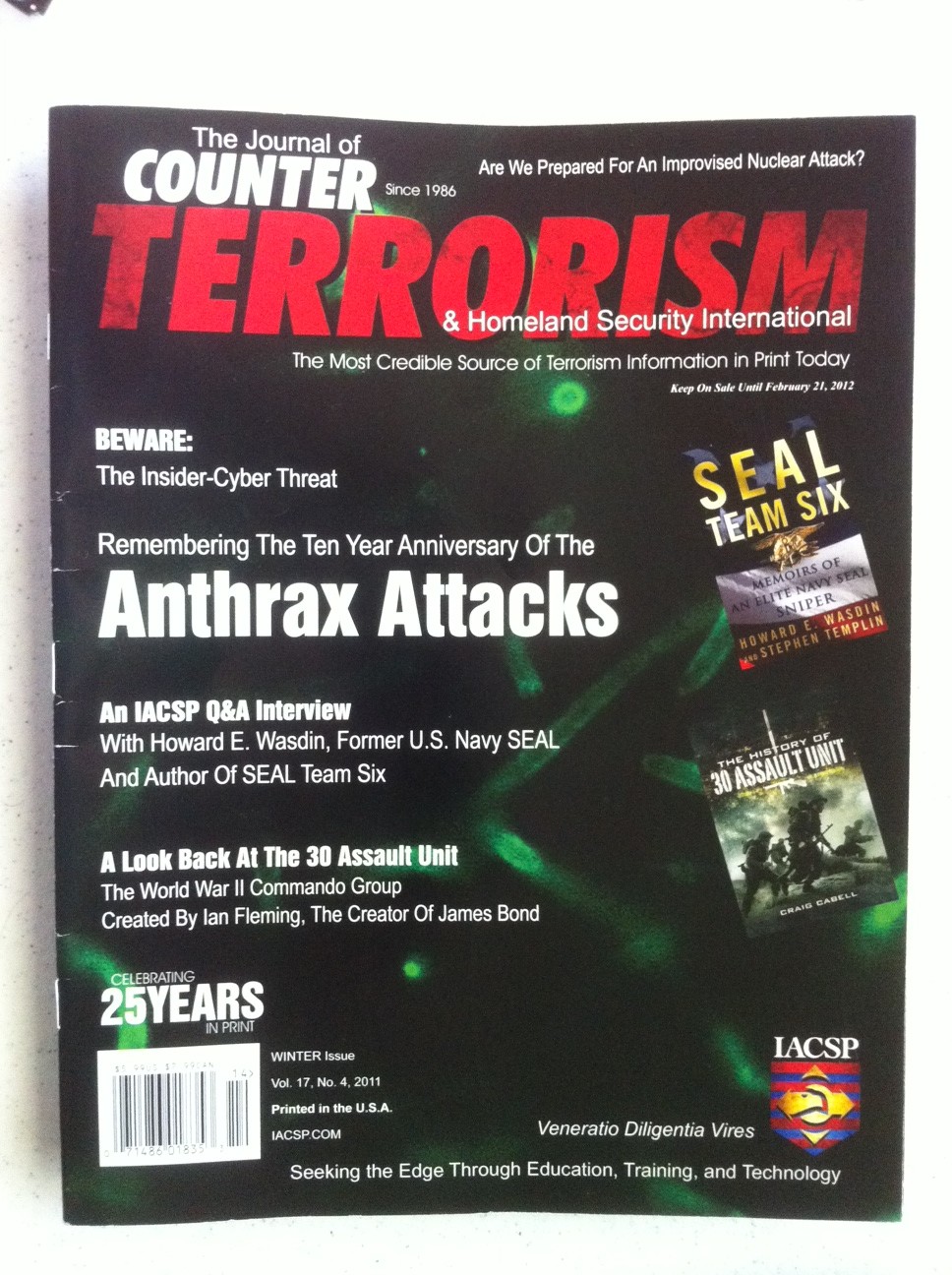 Articles:
The Insider-Cyber Threat
Ten Year Anniversary of the Anthrax Attacks
Interview with Howard Wasdin, former Navy SEAL
A Look Back At The 30 Assault Unit
Administration Continues To Warn About “anti-government exremists”
Posted by Brian in News, Threat Watch on 6/Feb/2012 19:10
From Reuters:
These extremists, sometimes known as “sovereign citizens,” believe they can live outside any type of government authority, FBI agents said at a news conference.
Legal convictions of such extremists, mostly for white-collar crimes such as fraud, have increased from 10 in 2009 to 18 each in 2010 and 2011, FBI agents said.
The Executive branch has an obsession with a tiny percentage of the population in the United States that believes they don’t have to follow any rules. The administration continues to point out these people as a serious threat, while denying any correlation between any terrorist attack and Islam. Where are the FBI warnings of Muslims preaching overthrow of the US government?
Terrorists Increasingly Target Military
Posted by Brian in News, Threat Watch, Warriors on 10/Dec/2011 12:00
From Military Times:
Law enforcement has prosecuted 33 domestic plots or attacks against military targets since Sept. 11, 2001, with most occurring in the last three years, according to a report released Wednesday by the House committee’s Republican staff. That represents more than half of the post-9/11 jihadist plots conceived by U.S. citizens, according to a Congressional Research Service report released last month.