- Comms
- Law
- Medic
- News
- Opinion
- Threat Watch
- Training
- Warrior Tools
- Accessories
- Ammo
- Body Armor
- Books
- Clothing
- Commo
- Gear
- Handguns
- Holsters
- Knives
- Long Guns
- ACC
- Accuracy International
- Barrett
- Benelli
- Beretta
- Blaser
- Bushmaster
- Custom
- CZ
- Desert Tactical Arms
- DPMS
- FN
- Forums
- HK
- IWI
- Kel-Tec Long Guns
- LaRue
- LWRC
- McMillan
- Mosin Nagant
- Mossberg
- Para
- Remington
- Rock River Arms
- Ruger Long Guns
- Sabre Defense
- Sako
- SIG Sauer
- SKS
- Smith & Wesson Long Guns
- Springfield
- Styer
- Weatherby
- Wilson Combat
- Winchester
- Magazines
- Maintenance
- Navigation
- Optics
- Sights
- Tech
- Warriors
Posts Tagged terrorism
FET works with Now Zad District governor to improve, rebuild area
From: HQ ARRC

Maj. Aniela K. Szymanski, the Civil Affairs Group team leader in Now Zad, Helmand province, Afghanistan, greets the deputy district governor, Haji Saied Abdul Quyum, at his compound, April 8. The meeting between Szymanski, Marines with the Female Engagement Team, and the district governor, Saied Murad Sadat covered the growth of the Now Zad women’s center, the local schools and other upcoming community improvement plans.
Story and phots by Lance Cpl. Katherine M. Solano
CAMP LEATHERNECK, Afghanistan – The female engagement team in Now Zad, Helmand province, Afghanistan, is pushing for the speedy development of a women’s center, new school and other community projects.
In an effort to move the plans along, the Marines and their interpreter met with the district governor, Saied Mourad Sadat, at his compound, April 8.
They have made progress in the short time they have been here, but acknowledge there is still a long way to go.
“I wish things would work short term, but everything takes a long time to accomplish,†said Sgt. Habiba Abida, a team leader with FET 12, Now Zad. “It’s hard to give yourself deadlines for certain goals.â€
The focus of the meeting was largely on the efficient development and management of the women’s center, but also on the female population in Now Zad as a whole.
“I’ve heard FET go and talk to females and ask what problems they have,†Sadat said. “Then [FET] comes and tells me what the women said so I can help, and it is positive for Now Zad and its people.â€
Staff Sgt. Martha Warren, the staff non-commissioned officer in charge of the Regimental Combat Team 8 FETs, asked the district governor what specific problems women in his district were having.
“There is nothing for the widows,†Sadat replied. “We are in the process of getting [females with skills] to work and teach each other to provide for themselves.â€
Warren, of Stone Park, Ill., also asked what specific impact FET was having on the local community.
“FET is a very good thing, because for the past five years with the war, lots of people have lost everything,†Sadat stated in response. “Females should know how to take care of themselves and their children.â€
This is one of the main objectives of FET: to give women the skills and knowledge they need to make a living for themselves or to help support their husbands and families.
“Females are important, because a lot of families here are poor,†Sadat said. “Husbands go to the Taliban for work, but if the wives can teach husbands to work with the government instead of with people who are trying to destroy the country or villages, it will be good.â€
They also discussed the hiring of a custodian for the women’s center, and how to teach local woman skills such as agriculture and sewing.
“I would love to say that by my first [mission break] I will have a full-time custodian at the women’s center, chickens for the coops, and sewing machines so the women could sew uniforms for Government of the Islamic Republic of Afghanistan public schools,†said Abida, an Arlington, Va., native.
Abida felt that progress was made, and plans to meet in the near future to continue discussions were set. The district governor closed the meeting with an invitation for the FET Marines, and others with their unit, to join him for a dinner at his compound later that evening.
The dinner included a bonfire, traditional Afghan meal, music and hookah, but little talk of business. The dinner was more about a celebration of the growing working relationship between the Marines and the people of Now Zad.
The Arab Risings, Israel and Hamas
Posted by Brian in News, Threat Watch on 12/Apr/2011 12:32
The Arab Risings, Israel and Hamas is republished with permission of STRATFOR.
By George Friedman
There was one striking thing missing from the events in the Middle East in past months: Israel. While certainly mentioned and condemned, none of the demonstrations centered on the issue of Israel. Israel was a side issue for the demonstrators, with the focus being on replacing unpopular rulers.
This is odd. Since even before the creation of the state of Israel, anti-Zionism has been a driving force among the Arab public, perhaps more than it has been with Arab governments. While a few have been willing to develop open diplomatic relations with Israel, many more have maintained informal relations: Numerous Arab governments have been willing to maintain covert relations with Israel, with extensive cooperation on intelligence and related matters. They have been unwilling to incur the displeasure of the Arab masses through open cooperation, however.
That makes it all the more strange that the Arab opposition movements — from Libya to Bahrain — have not made overt and covert cooperation with Israel a central issue, if for no other reason than to mobilize the Arab masses. Let me emphasize that Israel was frequently an issue, but not the central one. If we go far back to the rise of Egyptian President Gamal Abdel Nasser and his revolution for Pan-Arabism and socialism, his issues against King Farouk were tightly bound with anti-Zionism. Similarly, radical Islamists have always made Israel a central issue, yet it wasn’t there in this round of unrest. This was particularly surprising with regimes like Egypt’s, which had formal relations with Israel. Read the rest of this entry »
Gurkha gets UK´s 2nd Highest Medal for Bravery
From: The Himalayan Times

Sergeant Dip Prasad Pun - Pun fired 400 rounds, launched 17 grenades and detonated a mine to thwart the assault by Taliban fighters
KATHMANDU: A British Gurkha soldier who single-handedly fought off an attack by at least a dozen Taliban insurgents in Afghanistan has been awarded the United Kingdom’s second highest medal for bravery, British media reported.
Acting Sergeant Dip Prasad Pun, 31, who hails from western Nepal and serves in the British Army, exhausted all of his ammunition and resorted to using the tripod of his machine gun to repel the militants who were in 15 to 30 in number.
According to the BBC, he said he was very proud to be given the Conspicuous Gallantry Cross.
“I think I am a very lucky guy, a survivor,” he added. “Now I am getting this award, it is very great and I am very happy.”
From: Google
He said he thought the assault would never end and “nearly collapsed” when it was over, admitting: “I was really scared. But as soon as I opened fire that was gone — before they kill me, I have to kill some.”
How to Tell if Your Neighbor is a Bombmaker
Posted by Brian in Threat Watch on 8/Apr/2011 09:00
How to Tell if Your Neighbor is a Bombmaker is republished with permission of STRATFOR.
By Scott Stewart
Al Qaeda in the Arabian Peninsula (AQAP) released the  fifth edition of its English-language jihadist magazine “Inspire†on March 30. AQAP publishes this magazine with the stated intent of radicalizing English-speaking Muslims and encouraging them to engage in jihadist militant activity. Since its inception, Inspire magazine has also advocated the concept that jihadists living in the West should conduct attacks there, rather than traveling to places like Pakistan or Yemen, since such travel can bring them to the attention of the authorities before they can conduct attacks, and AQAP views attacking in the West as “striking at the heart of the unbelievers.â€
To further promote this concept, each edition of Inspire magazine has a section called “Open Source Jihad,†which is intended to equip aspiring jihadist attackers with the tools they need to conduct attacks without traveling to jihadist training camps. The Open Source Jihad sections in past editions have contained articles such as the pictorial guide with instructions titled “Make a Bomb in the Kitchen of Your Mom†that appeared in the first edition.
In this latest edition of Inspire there are at least three places where AQAP encourages jihadists to conduct “lone wolf†attacks rather than coordinate with others due to the security risks inherent in such collaboration (several jihadist plots have been thwarted when would-be attackers have approached government informants looking for assistance). In recent years there have been a number of lone wolf attacks inside the United States, such as the June 2009 shooting at an armed forces recruiting center in Little Rock, Ark.; the November 2009 Fort Hood shooting; and the failed bombing attack in New York’s Times Square in May 2010. Of course, the lone wolf phenomena is not just confined to the United States, as evidenced by such incidents as the March 2 shooting attack against U.S. military personnel in Frankfurt, Germany. Read the rest of this entry »
Libya’s Terrorism Option
Posted by Brian in News, Threat Watch on 24/Mar/2011 11:22
Libya’s Terrorism Option is republished with permission of STRATFOR.
By Scott Stewart
On March 19, military forces from the United States, France and Great Britain began to enforce U.N. Security Council Resolution 1973, which called for the establishment of a no-fly zone over Libya and authorized the countries involved in enforcing the zone to “take all necessary measures†to protect civilians and “civilian-populated areas under threat of attack.†Obviously, such military operations cannot be imposed against the will of a hostile nation without first removing the country’s ability to interfere with the no-fly zone — and removing this ability to resist requires strikes against military command-and-control centers, surface-to-air missile installations and military airfields. This means that the no-fly zone not only was a defensive measure to protect the rebels — it also required an attack upon the government of Libya.
Certainly, Libyan leader Moammar Gadhafi has no doubt that the U.S. and European military operations against the Libyan military targets are attacks against his regime. He has specifically warned France and the United Kingdom that they would come to regret the intervention. Now, such threats could be construed to mean that should Gadhafi survive, he will seek to cut off the countries’ access to Libyan energy resources in the future. However, given Libya’s past use of terrorist strikes to lash out when attacked by Western powers, Gadhafi’s threats certainly raise the possibility that, desperate and hurting, he will once again return to terrorism as a means to seek retribution for the attacks against his regime. While threats of sanctions and retaliation have tempered Gadhafi’s use of terrorism in recent years, his fear may evaporate if he comes to believe he has nothing to lose. Read the rest of this entry »
Countering Global Insurgency
Posted by Gary in Threat Watch, Training on 21/Mar/2011 17:09
From: Counterinsurgency by David Kilcullen
Countering Global Insurgency
Since the United States declared a global “war on terrorism†following the 9/11 terrorist attacks, some analysts have argued that terrorism is merely a tactic, thus a war on terrorism makes little sense. Francis Fukuyama’s comment that ” the war on terror” is a misnomer… terrorism is only a means to an end; in this regard, a war on terrorism makes no more sense than a war on submarines†is typical. This view is irrelevant in a policy sense (the term “war on terrorism†is a political, not an analytical, expression) but nonetheless accurate. Indeed, to paraphrase Clausewitz, to wage this war effectively, we must understand its true nature: neither mistaking it for nor trying to turn it into something it is not. We must distinguish Al Qaeda and the broader militant movements it symbolizes—entities that use terrorism—from the tactic of terrorism itself. In practice, as I will demonstrate, the “war on terrorism” is a defensive war against a worldwide Islamist jihad, a diverse confederation of movements that uses terrorism as its principle—but not its sole—tactic.
– Excerpt from,  Counterinsurgency by David Kilcullen  -2010
Body of soldier Liam Tasker brought back to Britain with the ashes of his dog
Posted by Jack Sinclair in News, Warriors on 11/Mar/2011 09:55

“The body of a Fife soldier who was killed in Afghanistan earlier this month has been flown back to Britain, along with the ashes of his loyal dog who died just hours after him.
Lance Corporal Liam Tasker (26), from the Royal Army Veterinary Corps, 1st Military Working Dog Regiment, became the 358th British soldier to die in Afghanistan since 2001, after he was shot on March 1 while he and his springer spaniel, Theo, were on patrol in Helmand Province.
liamtasker2
While Theo initially survived the attack, he died on return to the British base at Camp Bastion.
The pair, deemed “inseparable” by colleagues, were flown to RAF Lyneham in Wiltshire from Afghanistan on Thursday.”
GovSec 2011: March 29-30
Posted by Gary in Threat Watch, Training on 9/Mar/2011 14:48
The Government Security Expo and Conference
Tuesday – Wednesday, March 29-30, 2011
Washington D.C.
Gain valuable insights into key issues central to the protection of our nation through in-depth conference sessions and conference-only keynote addresses.
GovSec, The Government Security Expo and Conference, features an exposition with a full spectrum of physical, IT and cybersecurity solutions, alongside wireless and mobility communications equipment for federal, state and local governments. GovSec is a one-of-a-kind event that unites thousands of professionals tasked with securing our homeland, from the decision-makers at the federal level to the first responders, firefighters and police officers responding to catastrophic events in their hometown and every government security professional in between.  Attendance to the exposition is free for government, military, law enforcement and first responders as well as industry — new this year!
GovSec is co-located with U.S. Law, the U.S. Law Enforcement Conference and Exposition for federal, state and local law enforcement.
Gunman Targets U.S. Soldiers At Frankfurt Airport
Posted by Gary in News, Threat Watch, Warriors on 3/Mar/2011 17:09
From Stratfor
Red Alert: Gunman Targets U.S. Soldiers At Frankfurt Airport
March 2, 2011
Two people were killed and two were injured, at least one critically, in a shooting attack on U.S. military personnel at 3:20 p.m. local time March 3 at Germany’s Frankfurt International Airport. According to breaking news reports, an armed attacker boarded a U.S. military bus idling in front of Terminal 2 and began shooting. The two killed were a U.S. soldier and the driver of the bus, whose nationality is unclear. The perpetrator is alleged to be from Kosovo, of Albanian ethnicity and 21 years old, according to German media sources. According to news reports, the U.S. forces involved in the attack were on their way to Afghanistan.
There have been plots against U.S. military targets in Germany in recent years. The attack fits in the category of “armed jihadist assault” similar to what American-born Yemeni cleric Anwar al-Awlaki called for in mid-2010 in jihadist Internet chat rooms. Al-Awlaki had been tied to U.S. Maj. Nidal Hasan, who was charged with the November 2009 Fort Hood shooting.
Lance Corporal Liam Richard Tasker killed in Afghanistan
No doubt Tasker and Theo were targeted because they were saving lives by finding IEDs
From: MOD
2 Mar 11
It is with sadness that the Ministry of Defence must confirm that Lance Corporal Liam Richard Tasker, from the Royal Army Veterinary Corps, was killed in Afghanistan on Tuesday 1 March 2011.
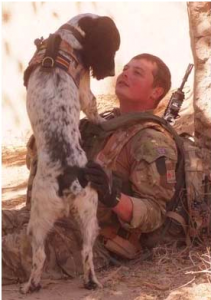
Lance Corporal Liam Tasker and Theo - MOD
Lance Corporal Tasker deployed to Afghanistan on 8 September 2010 as part of 1st Military Working Dog Regiment. Having trained as an Arms and Explosives Search dog handler, he was attached to 1st Battalion Irish Guards on 19 February 2011.
On 1 March 2011, LCpl Tasker was taking part in a patrol with his dog, Theo, when they were engaged by small arms fire, during which LCpl Tasker was struck and died from the injuries he sustained. Sadly on return to Camp Bastion, Theo suffered a seizure and died.
Lance Corporal Liam Richard Tasker
LCpl Liam Tasker was born on the 11 December 1984 in Kirkcaldy, Fife, Scotland. He joined the Army in 2001 and was originally a vehicle mechanic in the Royal Electrical and Mechanical Engineers. His passion though, was always dogs which led to his transfer to the Royal Army Veterinary Corps in 2007.
A trainer who had a natural empathy with dogs, he was a rising star within the Dog Training group. In 2010, he was posted to 104 Military Working Dog Squadron, St Georges Barracks, North Luffenham, Rutland, part of the 1st Military Working Dog Regiment.
From the onset of his operational tour in Afghanistan, he provided strong search and clearance capability for units across Helmand Province. In a short period of time, he had significant success locating Improvised Explosive Devices, weapons and bomb making equipment. His success undoubtedly saved many lives.
Lance Corporal Tasker was an outgoing, jovial and friendly character. He was extremely popular within the Squadron. His easy going, confident approach belied a consummate professional. He always strived to be the best and within the Squadron he was one of the best and he will be sorely missed by all in the Squadron.
He can never be replaced and will always be remembered. He was a fun, friendly, talkative character who always wanted the best from his dog, his troops, and himself.
He leaves behind his mother Jane Duffy, his father Ian Tasker, his brother Ian and his two sisters, Laura and Nicola, and girlfriend Leah.
Liam’s family said:
“There are three words that best describe Liam, larger than life. He lit up every room he walked into with his cheeky smile. He was the best son, grandson, brother and friend you could ever wish to meet. He died a hero doing a job he was immensely passionate about. We are so proud of him and everything he’s achieved. Words can’t describe how sorely he will be missed.
“Sleep well Liam you are forever in our hearts.”
Saudi with student visa in West Texas Arrested For “Attempted Use of Weapon of Mass Destruction”
Posted by Jack Sinclair in News, Threat Watch on 24/Feb/2011 16:23

“Moments ago, the Department of Justice announced that an investigation by the FBI’s Dallas Joint Terrorism Task Force has led to the arrest of 20-year-old Khalid Ali-M Aldawsari, who was born in Saudi Arabia but came to the United States in 2008 on a student visa so he could attend South Plains College in Levelland, just outside Lubbock.
The feds allege that Aldawsari attempted to buy chemicals needed to make an improvised explosive device, posted repeatedly to blogs promising to help defeat “the infidels” and kept a list of “potential U.S. targets.” Says the Department of Justice:
On Feb. 6, 2011, the affidavit alleges, Aldawsari sent himself an e-mail titled “Tyrant’s House,” in which he listed the Dallas address for former President George W. Bush. The affidavit also alleges that Aldawsari conducted research that could indicate his consideration of the use of infant dolls to conceal explosives and possible targeting of a nightclub with an explosive concealed in a backpack.”


The Moscow Attack and Airport Security
Posted by Brian in Opinion, Threat Watch on 28/Jan/2011 09:00
The Moscow Attack and Airport Security is republished with permission of STRATFOR.
By Scott Stewart
The Jan. 24 bombing at Moscow’s Domodedovo International Airport killed 35 people and injured more than 160. The attack occurred at approximately 4:40 p.m. as passengers from several arriving international flights were leaving the airport after clearing immigration and customs. The attacker (or attackers; reports are still conflicting over whether the attack was conducted by a man or a man and a woman together) entered the international arrivals hall of the airport, a part of the facility that is outside the secure area and that is commonly packed with crowds of relatives and taxi and limo drivers waiting to meet travelers.
Once the attacker was in the midst of the waiting crowd and exiting passengers, the improvised explosive device that he (or she) carried was detonated. It is not clear at this point whether the device was command-detonated by the attacker as a traditional suicide bomb or if the device was remotely detonated by another person. The attack was most likely staged by Islamist militants from Russia’s Northern Caucasus region who have conducted a long series of attacks in Russia, including the Aug. 24, 2004, suicide bombings that destroyed two Russian airliners.
The Domodedovo attack serves as a striking illustration of several trends we have been following for years now, including the difficulty of preventing attacks against soft targets, the resourcefulness of militants in identifying such targets and the fixation militants have on aviation-related targets. Read the rest of this entry »
The Mohammed Cartoon Dust Has Not Settled
Posted by Brian in Opinion, Threat Watch on 6/Jan/2011 15:47
The Mohammed Cartoon Dust Has Not Settled is republished with permission of STRATFOR.
By Scott Stewart
When one considers all of the people and places in the West targeted by transnational jihadists over the past few years, iconic targets such as New York’s Times Square, the London Metro and the Eiffel Tower come to mind. There are also certain target sets such as airlines and subways that jihadists focus on more than others. Upon careful reflection, however, it is hard to find any target set that has been more of a magnet for transnational jihadist ire over the past year than the small group of cartoonists and newspapers involved in the Mohammed cartoon controversy.
Every year STRATFOR publishes a forecast of the jihadist movement for the coming year. As we were working on that project for this year, we were struck by the number of plots in 2010 that involved the cartoon controversy — and by the number of those plots that had transnational dimensions, rather than plots that involved only local grassroots operatives. (The 2011 jihadist forecast will be available to STRATFOR members in the coming weeks.)
Groups such as al Qaeda in the Arabian Peninsula (AQAP) have gone to great lengths to keep the topic of the Mohammed cartoons burning in the consciousness of radical Islamists, whether they are lone wolves or part of an organized jihadist group, and those efforts are obviously bearing fruit. Because of this, we anticipate that plots against cartoon-related targets will continue into the foreseeable future. Read the rest of this entry »
Egypt and the Destruction of Churches: Strategic Implications
Posted by Brian in Opinion, Threat Watch on 4/Jan/2011 17:36
Egypt and the Destruction of Churches: Strategic Implications is republished with permission of STRATFOR.
By George Friedman
Over the past few days, Christian churches have been attacked in at least two countries — Nigeria and Egypt — while small packages containing improvised explosive devices were placed on the doorsteps of Christian families in Iraq. Attacks against Christians are not uncommon in the Islamic world, driven by local issues and groups, and it is unclear whether these latest attacks were simply coincidental and do not raise the threat to a new level or whether they indicate the existence of a new, coordinated, international initiative. There is a strong case to be made for the idea that there is nothing new in all of this.
Yet I am struck by the close timing of events in three distant and dispersed countries. Certainly, Egyptian intelligence services are looking for any regional connections (e.g., whether Iraqi operatives recruited the Egyptian bomber). While there have been previous bombings in Egypt, they have focused on tourists, not churches. What is important is this: If the recent attacks are not coincidental, then a coordinated campaign is being conducted against Christian churches that spans at least these countries. And it is a network that has evaded detection by intelligence services.
Obviously, this is speculative. What is clear, however, is that the attack on a church in one country — Egypt — is far from common and was particularly destructive. Egypt has been relatively quiet in terms of terrorism, and there have been few recent attacks on the large Coptic Christian population. The Egyptian government has been effective in ruthlessly suppressing Islamist extremists and has been active in sharing intelligence on terrorism with American, Israeli and other Muslim governments. Its intelligence apparatus has been one of the mainstays of global efforts to limit terrorism as well as keep Egypt’s domestic opposition in check.
Therefore, the attack in Egypt is significant for no other reason than that it happened and represents a failure of Egyptian security. While such failures are inevitable, what made this failure significant was that it occurred in tight sequence with attacks on multiple Christian targets in Iraq and Nigeria and after a threat al Qaeda made last month against Egyptian Copts. This was a warning, which in my mind increases the possibility of coordinated action, but the Egyptians failed to block it. Read the rest of this entry »
Separating Terror from Terrorism
Posted by Brian in Opinion, Threat Watch on 3/Jan/2011 16:44
Separating Terror from Terrorism is republished with permission of STRATFOR.
By Scott Stewart
On Dec. 15, the FBI and the Department of Homeland Security (DHS) sent a joint bulletin to state and local law enforcement agencies expressing their concern that terrorists may attack a large public gathering in a major U.S. metropolitan area during the 2010 holiday season. That concern was echoed by contacts at the FBI and elsewhere who told STRATFOR they were almost certain there was going to be a terrorist attack launched against the United States over Christmas.
Certainly, attacks during the December holiday season are not unusual. There is a history of such attacks, from the bombing of Pan Am Flight 103 on Dec. 21, 1988, and the thwarted millennium attacks in December 1999 and January 2000 to the post-9/11 airliner attacks by shoe bomber Richard Reid on Dec. 22, 2001, and by underwear bomber Umar Farouk Abdulmutallab on Dec. 25, 2009. Some of these plots have even stemmed from the grassroots. In December 2006, Derrick Shareef was arrested while planning an attack he hoped to launch against an Illinois shopping mall on Dec. 22.
Mass gatherings in large metropolitan areas have also been repeatedly targeted by jihadist groups and lone wolves. In addition to past attacks and plots directed against the subway systems in major cities such as Madrid, London, New York and Washington, 2010 saw failed attacks against the crowds in New York’s Times Square on May 1 and in Pioneer Courthouse Square in downtown Portland, Ore., on Nov. 26. Read the rest of this entry »